

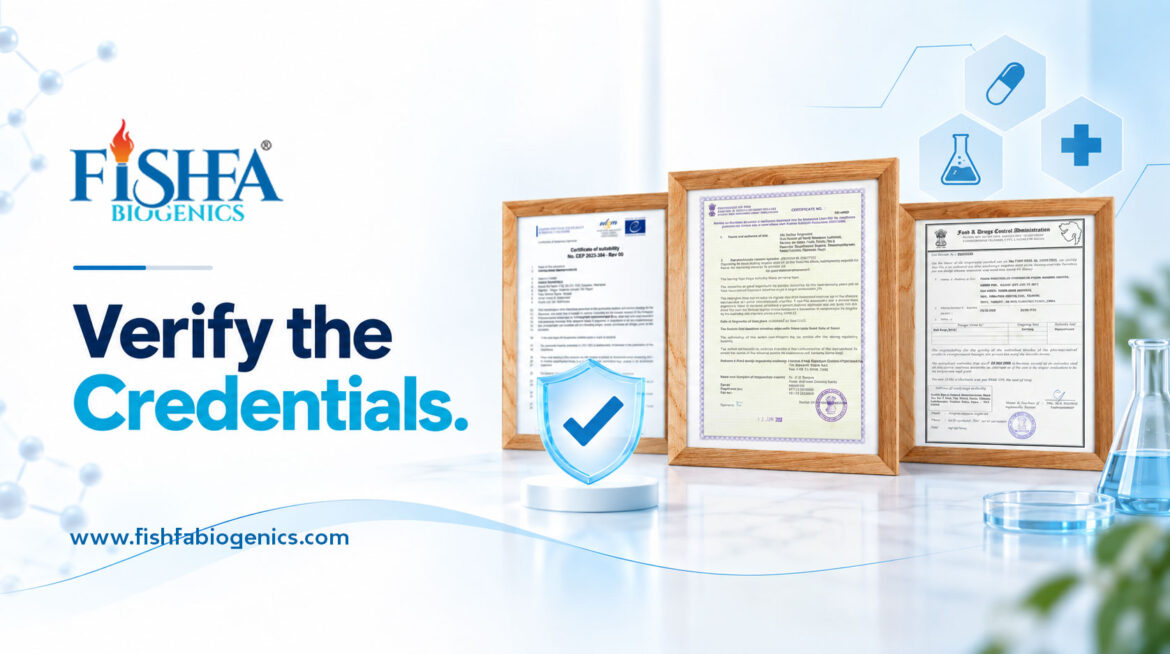
When sourcing an active pharmaceutical ingredient, the conversation often starts with supply capacity. But for pharmaceutical buyers, one question becomes increasingly important ad the product moves towards registration or international markets: what can the manufacturer actually prove?
A certified API manufacturer and supplier should be able to demonstrate more than a certificate on a website. Regulatory credentials can reveal where a product has been submitted, which authority is involved, whether a certificate has been received, and whether a specific API is supported by the required documentation. This distinction becomes particularly important when sourcing regulated products such as Tacrolimus, Cyclosporine API, Mupirocin API and Mupirocin Calcium.
Credentials Tell More Than Certifnicates
A regulatory credential is useful only when you understand what it relates to. A certificate may apply to a specific product, grade, market, or regulatory pathway rather than representing blanket approval for everything manufactured by a company. This is why an API supplier’s accreditation information deserves closer attention.
Fishfa Biogenics’ regulatory information, for example, presents product-wise details across different markets and authorities. Its listed Tacrolimus credentials include USP and Ph. Eur. grades, with regulatory progress shown for markets including the United States, Europe, South Korea, Malaysia, and Vietnam. The difference between terms such as Submitted, Certificate Received, and VAI Received is also important because each represents a different stage of regulatory progress. For buyers, this level of detail is far more meaningful than a generic statement that a manufacturer is “internationally certified.”
What Regulatory Details Actually Matter
For an API buyer, regulatory evaluation should connect several pieces of information rather than focusing on one certificate in isolation. The API grade matters because USP, BP, and Ph. Eur. specifications can serve different market requirements. The destination market matters because regulatory expectations vary between authorities.
Documentation such as a Drug Master File (DMF) can also be relevant when a product is being evaluated for registration or commercial supply. Fishfa’s accreditation information illustrates this product-specific approach: its Tacrolimus USP entry for the United States is listed with DMF 41828, while Mupirocin Calcium USP is listed with DMF 42235. Meanwhile, its Cyclosporine and Mupirocin Calcium entries show different regulatory positions across markets. For procurement and regulatory teams, these details help create a clearer picture of what is actually available for a particular market rather than relying on broad supplier claims.
One API, Different Regulatory Status
The same API name does not automatically mean the same regulatory position everywhere. Tacrolimus suppliers, for instance, may have different documentation or regulatory progress depending on the market and grade being supplied. The same principle applies to Cyclosporine API and Mupirocin Calcium. A product may have a certificate in one market while its regulatory submission is still in progress in another. This is why buyers should avoid treating a manufacturer’s entire portfolio as having one uniform regulatory status.
Instead, the relevant question is more specific: What is the regulatory status of this exact API, in this exact grade, for the market where I intend to use it?
That simple shift in thinking can make supplier evaluation much more practical and reduce confusion during qualification and registration discussions.
Evaluating API Manufacturers in Gujarat
For companies evaluating API manufacturers in Gujarat, regulatory credentials should be considered alongside manufacturing capability, quality systems, documentation, consistency, and supplier support. Fishfa Biogenics, based in Rajkot, Gujarat, has an API portfolio that includes Tacrolimus, Cyclosporine, Mupirocin, and Mupirocin Calcium.
Its accreditation information provides a product- and market-specific view of its regulatory activities rather than presenting certification as a single blanket claim. For buyers, that approach makes the information easier to assess against their own sourcing requirements.
Before moving forward with any certified API manufacturer and supplier, it is worth asking for the documentation relevant to the intended product and market, confirming the applicable grade, understanding the current regulatory status, and establishing whether the manufacturer can support the requirements of the target market. In API sourcing, credibility is strongest when it can be demonstrated with specific, verifiable details.
Looking for a Certified API Manufacturer and Supplier?
Explore Fishfa Biogenics’ API portfolio and regulatory credentials to understand its capabilities across Tacrolimus, Cyclosporine API, Mupirocin API, and Mupirocin Calcium.
FAQs
- What does a certified API manufacturer do?
A certified API manufacturer produces active pharmaceutical ingredients under applicable quality and regulatory requirements and maintains documentation needed to demonstrate product quality and manufacturing controls.
- Why are regulatory credentials important when sourcing APIs?
Regulatory credentials can help buyers understand a product’s regulatory position, applicable market, documentation, and progress with relevant authorities.
- Are all APIs from one manufacturer approved in every market?
No. Regulatory status can vary by API, grade, country, and regulatory authority. A product submitted or certified in one market may have a different status elsewhere.
- Which APIs does Fishfa Biogenics manufacture?
Fishfa Biogenics’ API portfolio includes Tacrolimus, Cyclosporine, Mupirocin, and Mupirocin Calcium, among other pharmaceutical ingredients.